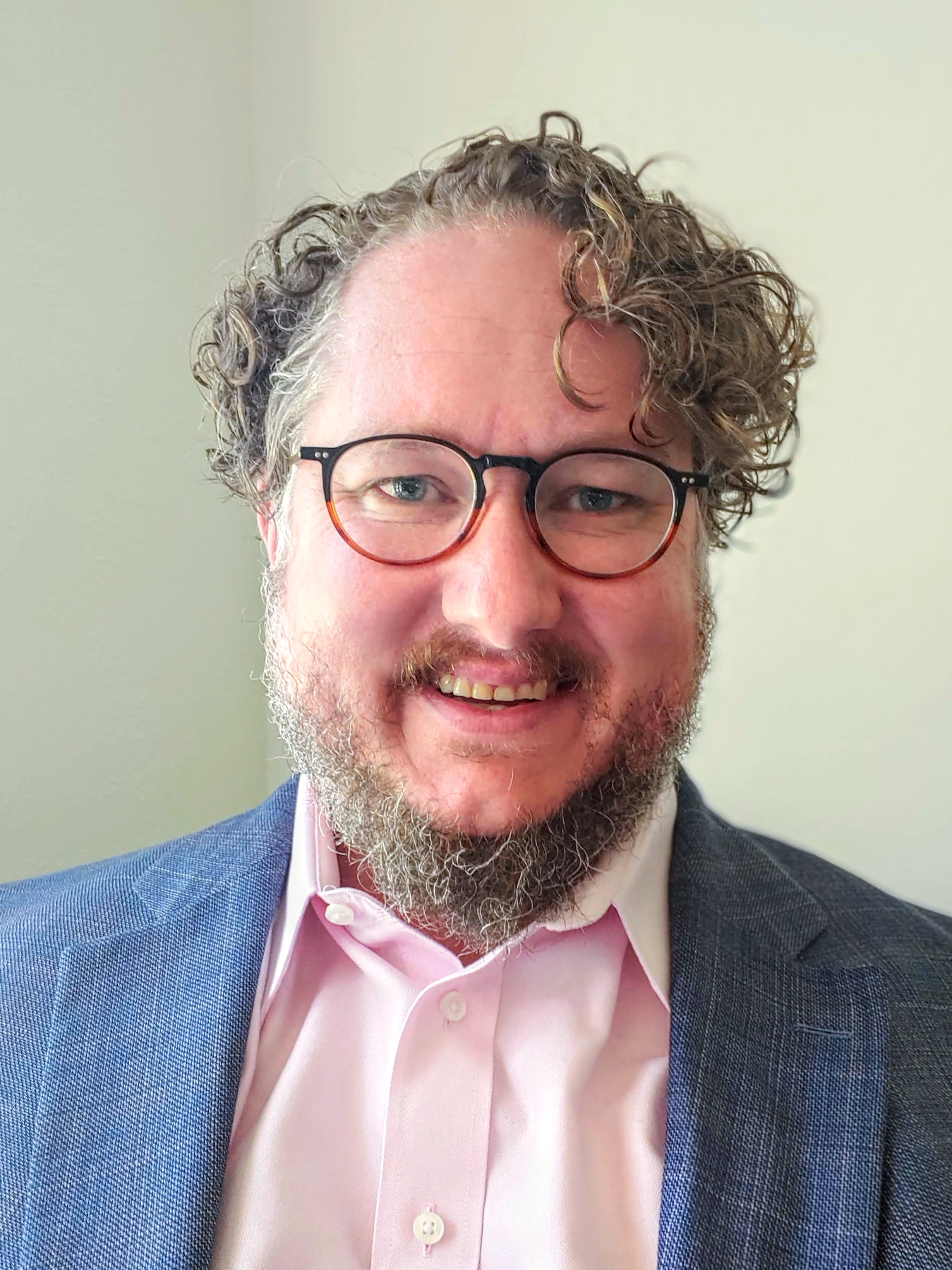
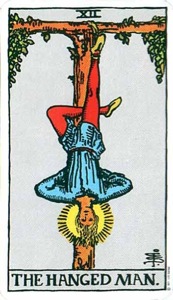
I’m Matthew J. Brown aka Matt Brown aka Mattbrown aka Matt. Known online since about 1994, or anyhow before I kept any records of such things, by the handle“the hanged man.”
The more I get into philosophical and philosophy-adjacent discussions of current-generation “artificial intelligence” (large language models and the like), the more dismayed I am not to see any discussion of the large body of relevant work by Paul Churchland. Continue reading →
I like these little glimpses into Internet Past… one of the things I like is how these kinds of discussions help us think about not only how we got where we are, but the contingency of the current way of things, which also entails the possibility of a different future than the trajectory we seem to find ourselves on. Continue reading →
Spring 2013 saw another round of misguided right-wing attacks on basic scientific research in the U.S. Congress, a political tactic that purports to demonstrate the wastefulness of the federal government by showing off the price tag (often small in terms … Continue reading →
A couple of weeks back, Justin Weinberg at the Daily Nous posed a really interesting question. The context was Daniel Dennett’s review of Alfred Mele’s book Free: Why Science Hasn’t Disproved Free Will. Dennett gives a relatively standard story about … Continue reading →
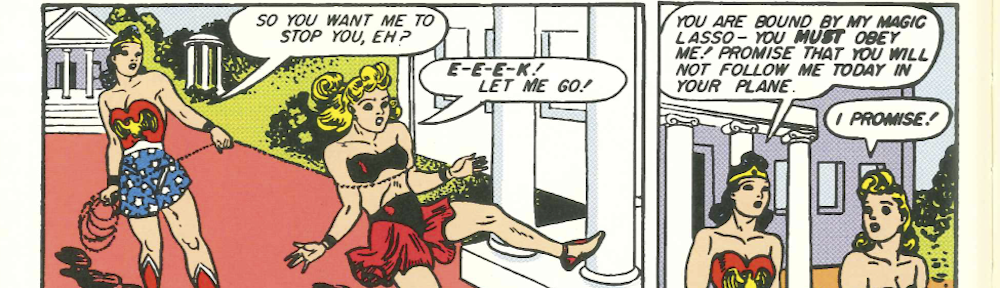
I’ve just begun reading Jill Lepore’s new book about Wonder Woman and William Moulton Marston. So far, I’m finding it to be really thorough and excellent! [Edit: My final assessment was much more mixed.] I was a little disturbed, though, to … Continue reading →
“The Hanged Man” was an online alias or “handle” I adopted somewhere around 1994, when I didn’t even have access to the internet and instead was using local dialup bulletin board systems (BBS’s). I continued to use the name on into the next … Continue reading →
A week ago, on April 13th, my friend Dale Dorsey died, suddenly and unexpectedly, in his office at the University of Oxford.
I have known Dale for over twenty years. He was one year ahead of me in graduate school at UC San Diego, but he was four years older than me, which in my early twenties still seemed like a gap; he had more life experience and seemed a good bit wiser than me. I learned a lot from him. I remember meeting him when I was a prospective graduate student. He was in the office next to mine, and kept something like banker’s hours, being in his office regularly through most of the work day. I was much less consistent and certainly much less of a morning person, but we still saw each other nearly every weekday for the better part of the four years we overlapped. He helped me learn how to be a graduate student and a philosopher. We talked about life and work, friends and relationships, department gossip, the need for occasional bouts of clean livin’. He came into my office regularly to ask my intuition about various ethical dilemmas and thought experiments, and often found my intuitions lacking. He was a mentor as well as a friend.
I kept in touch with Dale after grad school. He came back to visit regularly in his first year or two after graduating, because he was dating a fellow student and dear friend who was a year behind me. Once I took my first job in Texas, he and Erin came out to visit us at our new house. I stood up with him at their wedding. By lucky chance, Sabrina got involved in a summer program at the University of Kansas, where Dale and Erin were teaching, which would bring us out to visit for a week or so every year or two for a good stretch. We reconnected periodically in Lawrence and in Dallas, in Chicago and in New Orleans, and lately in Carbondale. We managed to stay a part of each others’ lives despite the sort of distance and time that makes that hard for grad school friends.
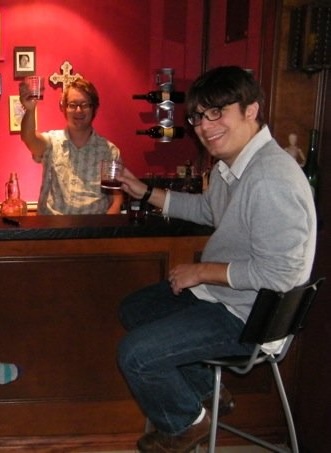
Thanksgiving 2009, Dallas
Dale enjoyed good food and good drink. He was a musician and a music lover; he sang a Talking Heads song at Sabrina’s and my wedding. He thought seriously and laughed easily. He got along with pretty much everybody and was beloved by many. We worked on pretty distant topics in philosophy, and our views and tendencies were very different on most topics, but I always enjoyed talking philosophy with him. He was always interested in what I was doing, and always had new ideas to talk about. He was one of the most prolific writers I know, and his work was always good enough to make it into the best venues. He was the only philosopher I knew outside of philosophy of science, logic, or formal philosophy who used LaTeX to write most of his papers, I think just because he liked the way it looked better on the page than a Word document. His work was engaged with fundamentally important questions about how to live life well; it was both carefully engaged with the ideas that came before and generative of fruitful new conversations. His work could be careful and clear, dry and technical, charming and funny by turns. I wish I had read more of it while he was still here to talk to about it.
He was, apparently, the happiest he’d ever been in Oxford. I was looking forward to hearing about his life there when we came for a planned visit this summer. I saw him less than a year ago, not long before they moved across the Atlantic. He was excited about the move. In an interview, when asked what he hoped to achieve in his new position there, he said, “First and foremost, I’d like my students to succeed, in whatever sense of success is meaningful to them. I’m also hopeful that I can fit into the wonderful community here at Somerville and Oxford. And maybe get a bit of writing done, too.” It sounds like Dale. I am glad he was so happy there, and I am sad that he did not get to spend more time in that happy place, working towards those goals.
Dale wrote an article on what it means to have “A Good Death” (2017). To quote his conclusion, “When one’s death is part of, unified by, the project of his or her life, this death bears intrinsic good-making features. For some people, this intrinsic good-making feature is enough to render this death intrinsically good tout court. And for some of those people, the intrinsic goodness of death is enough to outweigh its potential instrumental disvalue.” I have little doubt that Dale died doing what he loved, working in an office in a beautiful old Oxford college. He died at the top of his intellectual powers, with an exciting new book forthcoming with Oxford UP and an article forthcoming at the Journal of Philosophy. He built intellectual networks and institutions that will outlive him. He surely left some work undone, but I think it fair to say that his death was part of his life-project. He also left behind a wife and two daughters who really needed him and who were surely an equally important part of his projects. He died quickly. He died too young. I don’t know how to sort out how good or bad his death was, but I am sad that we can’t have a long conversation trying to sort out what his view implies about his case.
My heart hurts for Erin and their two kids. All across the world, there are friends, students, colleagues, and other lives he touched, in mourning. I join the chorus now, although nothing I have to say feels quite right. I can’t capture my fondness and love for the man, my devastation at his lost, my heartbreak for all those many people whose devastation is surely deeper than mine. So you’re telling me, that’s all the Dale Dorsey we get?